Waipu Beach


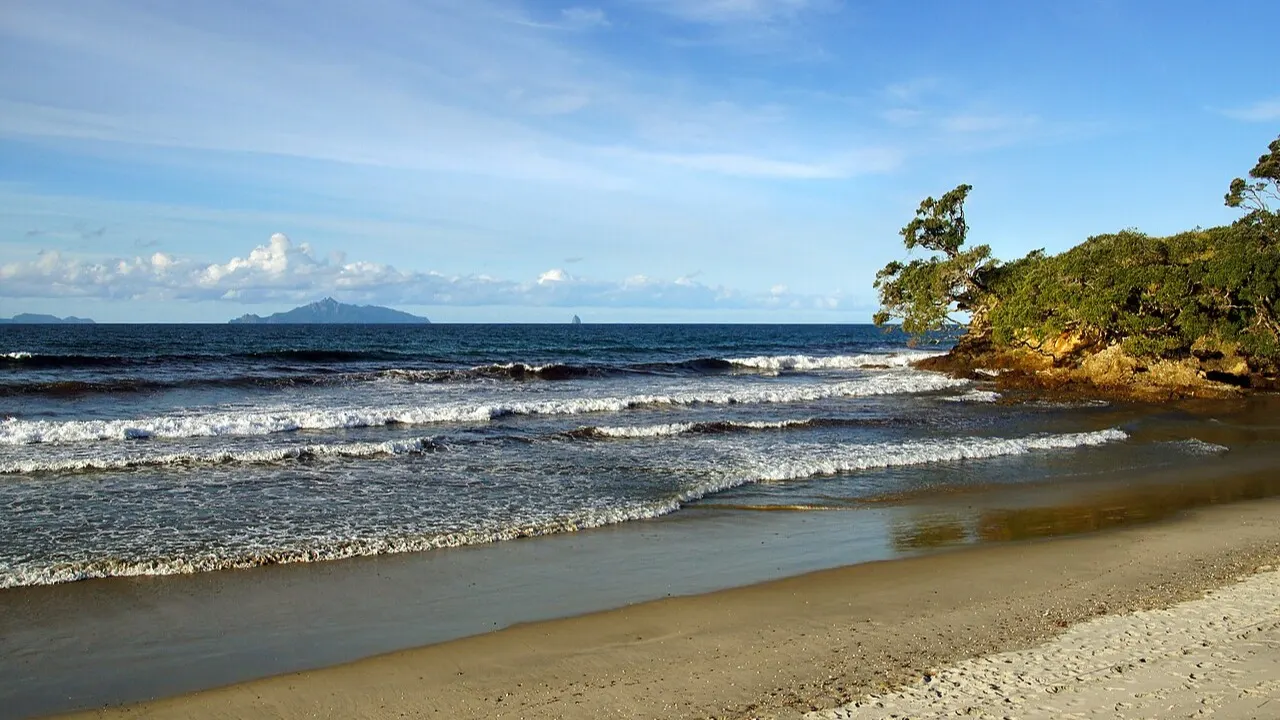

Photo credits: Sgroey (CC BY-SA 4.0); tdes (CC BY 3.0); Bernard Spragg. NZ from Christchurch, New Zealand (CC0)
Getting there
Waipu Beach sits at the head of Bream Bay at the southern end of Northland, on New Zealand's east coast facing the open Tasman Sea. It is an easy stop between Whangarei and Auckland, and the Waipu township lies just behind the dunes.
Things to do nearby
The long, straight golden beach is a popular surf spot in summer, when the surf club provides patrols. At the northern end, the Waipu River estuary and wetlands shelter some of New Zealand's rarest shorebirds and terns, including the fairy tern — a rewarding destination for birdwatchers.
Highlights
The beach's appeal is its scale and simplicity: kilometres of unbroken sand backed by dunes and open ocean horizons. Outside the summer holiday season it becomes a quiet place for long beach walks and sunsets, while summer brings holiday homes and campers to life.
History & culture
Behind the dunes, the town of Waipu was founded in the 1850s by Gaelic-speaking settlers from Nova Scotia, Canada. Their descendants have kept a distinctly Scottish flavour alive in the district, which is unusual for Northland.
Booking & rules
The beach is free to visit year-round. Swim between the flags where surf patrols operate in summer. In the northern estuary, respect the wildlife sanctuary: keep your distance from birds and observe the dog-control signage, as pets are restricted in protected areas.
About this attraction
Waipu Beach runs along the head of Bream Bay at Northland's southern end — a long, straight ribbon of golden sand backed by dunes and facing the open Tasman, one of the most convenient surf-and-holiday beaches between Whangarei and Auckland. In summer the bach community and campgrounds fill up; out of season it reverts to a quiet stretch for walking and sunsets. The surf club patrols in summer. At the northern end, the estuary wetlands are a wildlife refuge for some of New Zealand's rarest shorebirds, including the fairy tern — watch from a distance and obey the pet-control signs. Behind the dunes lies Waipu township, settled in the 1850s by Gaelic-speaking Nova Scotians, whose descendants still give the district its distinct Scottish flavour.
Highlights
Swim between the flags in summer, walk the dune-backed length of sand towards the estuary with binoculars for the rare terns, and stay for the west-facing sunset.
Cautions
Swim in the patrolled area between the flags in summer and watch for rips along this west-facing coast. Keep well back from the bird refuge at the estuary and obey dog-control signs.
Getting there
Leave SH1 at Waipu and drive about 10 minutes to the beach, where parking is available; spaces tighten on summer weekends.
noda attraction index 82
4.1 / 5
How the attraction index works
Each attraction is scored from five verifiable data points, out of 100. This is an editorial index, not a user rating — it reflects how free, how scenic and how well documented a place is, not anyone's personal experience.
| Free bonus | 20 pts | Completely free 20; small fees (parking, gold-coin koha) 10; expensive tickets 0. |
|---|---|---|
| Scenery uniqueness | 25 pts | World Heritage or landmark-level 25, regional 18, local 12 — each listing is explicitly tiered. |
| Things to do | 20 pts | Ranked by the depth of the highlights write-up: full 20, medium 14, brief 10. |
| Information completeness | 20 pts | 15 for having about, best time, cautions and access notes, minus 4 per missing item; plus 5 for two or more official sources. |
| Accessibility | 15 pts | Reachable by car 15, short walk 12, long tramp required 6. |
Things to do nearby · Events
- Viaduct Harbour presents The Reflection Tree by Angus Muir
 Japanese film screening: Exit 8
- 'Twas The Night Before Bull Rush: The Musical
- Danny O'Brien: Sure Look, Be Grand (Ireland)
 Rebel Without Applause
 Crowded Trousers
 Ngā Waka Whiria: Hauora and Leadership in Construction
 Wahine Toa - Womens Adventure Film Festival