Te Rewa Rewa Bridge
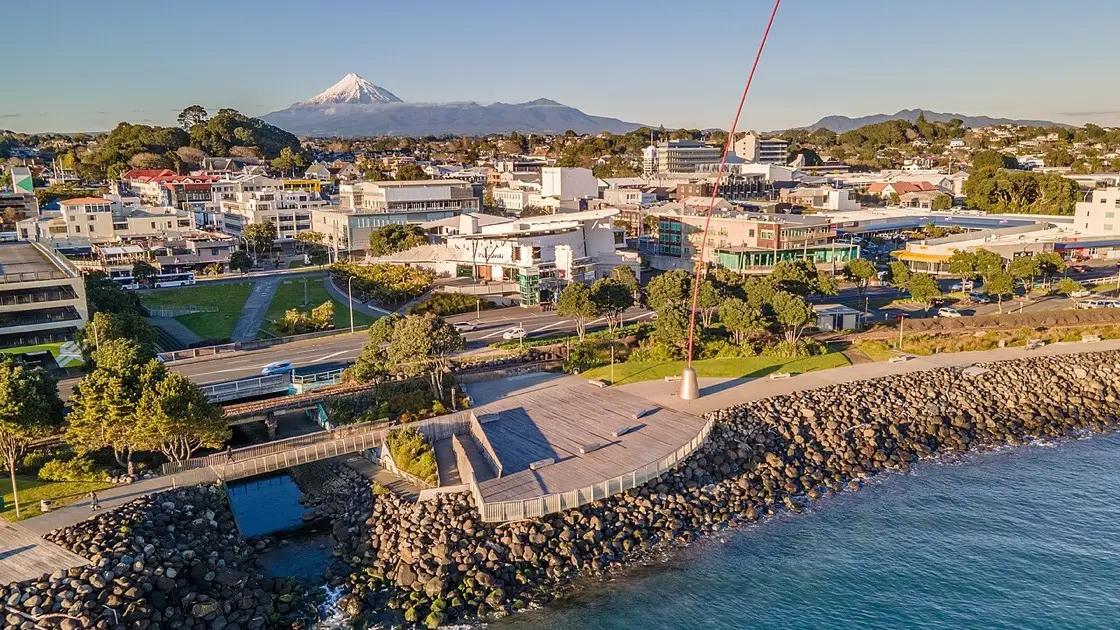
Photo credits: Itineris55 (CC0 / CC BY-SA 4.0); Mknz24 (CC BY-SA 4.0)
Getting there
Te Rewa Rewa Bridge crosses the Waiwhakaiho River in a semi-rural area of New Plymouth, Taranaki, New Zealand (39°02′S, 174°07′E). It carries pedestrians and cyclists as part of the Coastal Walkway's northern extension, which links New Plymouth with the neighbouring settlement of Bell Block.
Things to do nearby
The bridge is a signature stop on the Coastal Walkway, connecting New Plymouth and Bell Block. From the bridge you can walk or cycle the coastal path in either direction, and the gravel river mouth and surf line below offer their own photography. The classic shot frames the skewed steel arch with Mount Taranaki behind it.
Highlights
The 70 m bridge rises 10 m at its highest point over a single 68.8 m span, with 19 steel ribs forming an arch said to evoke a breaking wave or whale skeleton. Ribs aligned with the prevailing wind frame Mount Taranaki perfectly when viewed while leaving the sacred ground. Golden-hour photography here is a rite of passage; early mornings are often quiet enough to have the bridge to yourself.
History & culture
A historic pā stands on the north river bank; the site, known as Rewa Rewa, is a burial ground and was the site of a battle during the Musket Wars. The northern walkway extension was enabled by a special agreement between Ngāti Tawhirikura hapū and the New Plymouth District Council. Designer Peter Mulqueen intended the bridge to 'touch lightly' on the Rewa Rewa side to honour the deceased, with the wind-shaped arch symbolising the enduring spirit of the dead and the framed mountain promising what is eternal. The bridge opened on 5 June 2010 and won the 2011 Arthur G. Hayden Medal and the 2011 International Footbridge Award for aesthetics.
Booking & rules
The bridge is open to the public at all times and free to cross, carrying both pedestrians and cyclists — the deck is wide enough (2.5 m) for both, and its 68.8 m span was engineered to carry ambulances and service vehicles. No booking is required. Built with no piers in the water and a deck 4.5 m above normal flow level to withstand floods and lahars, it saw 55,756 users in July 2010, its first full month.
About this attraction
Te Rewa Rewa is the Coastal Walkway's signature crossing: white ribs sweep across the Waiwhakaiho River like the skeleton of a whale or a breaking wave, and from the right angle the arch frames Mount Taranaki perfectly. Built for walkers and cyclists, it turns a river mouth of shingle flats and surf into the region's most photographed piece of infrastructure. Come at dawn and you may have it to yourself; come at golden hour and bring a wide lens.
Highlights
Frame the mountain through the arch at sunrise, walk the river-mouth beach beside the bridge, and continue along the walkway in either direction to make a longer coastal loop.
Cautions
The bridge deck is shared by cyclists — keep to one side; the river mouth is windswept with little shelter.
Getting there
On the Coastal Walkway just east of New Plymouth; free parking near the Waiwhakaiho river mouth, or ride/walk from the foreshore.
noda attraction index 79
4.0 / 5
How the attraction index works
Each attraction is scored from five verifiable data points, out of 100. This is an editorial index, not a user rating — it reflects how free, how scenic and how well documented a place is, not anyone's personal experience.
| Free bonus | 20 pts | Completely free 20; small fees (parking, gold-coin koha) 10; expensive tickets 0. |
|---|---|---|
| Scenery uniqueness | 25 pts | World Heritage or landmark-level 25, regional 18, local 12 — each listing is explicitly tiered. |
| Things to do | 20 pts | Ranked by the depth of the highlights write-up: full 20, medium 14, brief 10. |
| Information completeness | 20 pts | 15 for having about, best time, cautions and access notes, minus 4 per missing item; plus 5 for two or more official sources. |
| Accessibility | 15 pts | Reachable by car 15, short walk 12, long tramp required 6. |