Farewell Spit & Cape Farewell

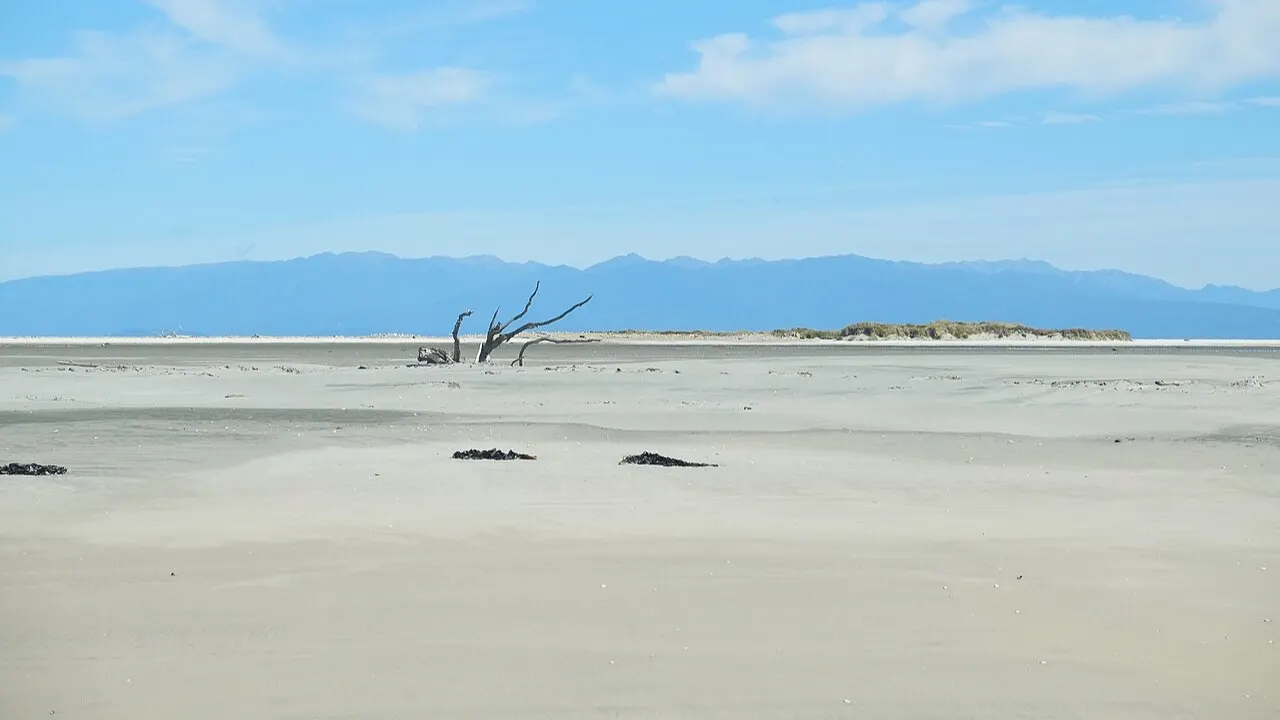


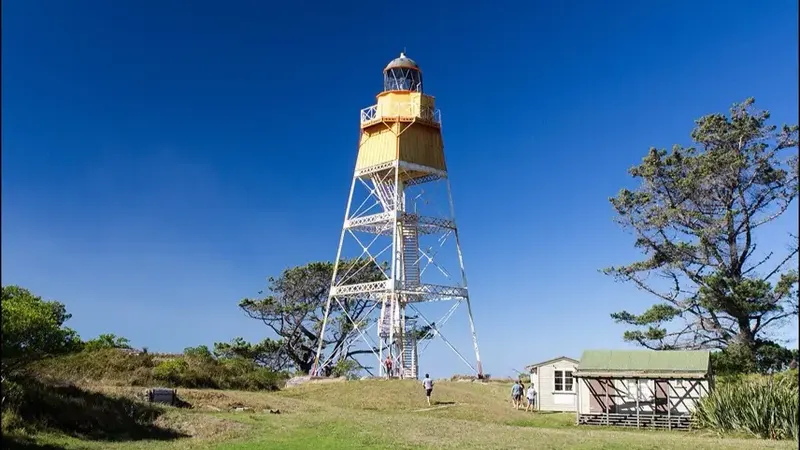


Photo credits: Pseudopanax at English Wikipedia (Public domain); Oren Rozen (CC BY-SA 3.0); NASA/GSFC/METI/ERSDAC/JAROS, and U.S./Japan ASTER Science Team (Public domain)
Getting there
Farewell Spit lies at the northern end of Golden Bay, South Island, about 50 km north of Tākaka and 20 km from Collingwood, running eastwards from Cape Farewell — the northernmost point of the South Island. The small settlement of Pūponga sits close to the landward end of the spit.
Things to do nearby
Nearby are Wharariki Beach, the Pūponga Farm Park walking area, and the dramatic cliffs and sea arch at Cape Farewell. Beyond the spit itself, Golden Bay's tidal flats reveal rich birdlife; the 4WD eco-tours visit the lighthouse area and the gannet colony at the spit's end.
Highlights
New Zealand's longest sand spit (about 25 km of stable land plus 5 km of mobile sand), built from golden quartz sands swept up the West Coast from the Southern Alps. Tides can recede seven kilometres, exposing 80 km² of mud flats; dunes migrate east under winds averaging over 25 km/h. The spit's end holds the world's only sea-level Australasian gannet colony (about 10,000 birds in 2022) and New Zealand's only steel lattice lighthouse, whose light is visible for 35 km.
History & culture
Māori name Onetahua, 'heaped up sand'. Abel Tasman sighted it in 1642; Captain Cook named Cape Farewell in 1770, the last land he saw leaving New Zealand. The lighthouse was first lit in 1870 after many shipwrecks (including the Queen Bee in 1877) and replaced in 1897. The spit is also a notorious 'whale trap' where long-finned pilot whales repeatedly strand.
Booking & rules
Administered by the Department of Conservation as a nature reserve (IUCN Ia); the spit was protected as a flora and fauna reserve in 1938 and became a Ramsar wetland in 1976. Entry beyond the first 4 km requires a permit, available only through licensed four-wheel drive bus tours from Collingwood or Pūponga. Best wildlife viewing depends on tide state; bring binoculars. A pest-eradication project aims to clear mammals from the spit by late summer 2026.
About this attraction
Farewell Spit is a 25-kilometre dune system arcing into the Tasman Sea, a protected bird sanctuary for shorebirds and gannets. Public access stops a few kilometres along the spit; guided 4WD eco-tours from Collingwood go further. Nearby, the clay cliffs of Cape Farewell give the road-end view.
Highlights
Walk the first kilometres of the spit from Puponga Farm Park, watch the gannet colonies and wader flocks, drive to the Cape Farewell lookout, and join a 4WD eco-tour deeper onto the spit.
Cautions
The spit is a sanctuary — stay on marked routes and never disturb the birds; the cape is sheer and very windy, so keep back from crumbling cliff edges.
Getting there
About a 40-minute drive from Collingwood, the last stretch partly gravel; no public transport — self-drive or join a tour.
noda attraction index 88
4.4 / 5
How the attraction index works
Each attraction is scored from five verifiable data points, out of 100. This is an editorial index, not a user rating — it reflects how free, how scenic and how well documented a place is, not anyone's personal experience.
| Free bonus | 20 pts | Completely free 20; small fees (parking, gold-coin koha) 10; expensive tickets 0. |
|---|---|---|
| Scenery uniqueness | 25 pts | World Heritage or landmark-level 25, regional 18, local 12 — each listing is explicitly tiered. |
| Things to do | 20 pts | Ranked by the depth of the highlights write-up: full 20, medium 14, brief 10. |
| Information completeness | 20 pts | 15 for having about, best time, cautions and access notes, minus 4 per missing item; plus 5 for two or more official sources. |
| Accessibility | 15 pts | Reachable by car 15, short walk 12, long tramp required 6. |