What Xi, Putin and Trump wanted – and what they got
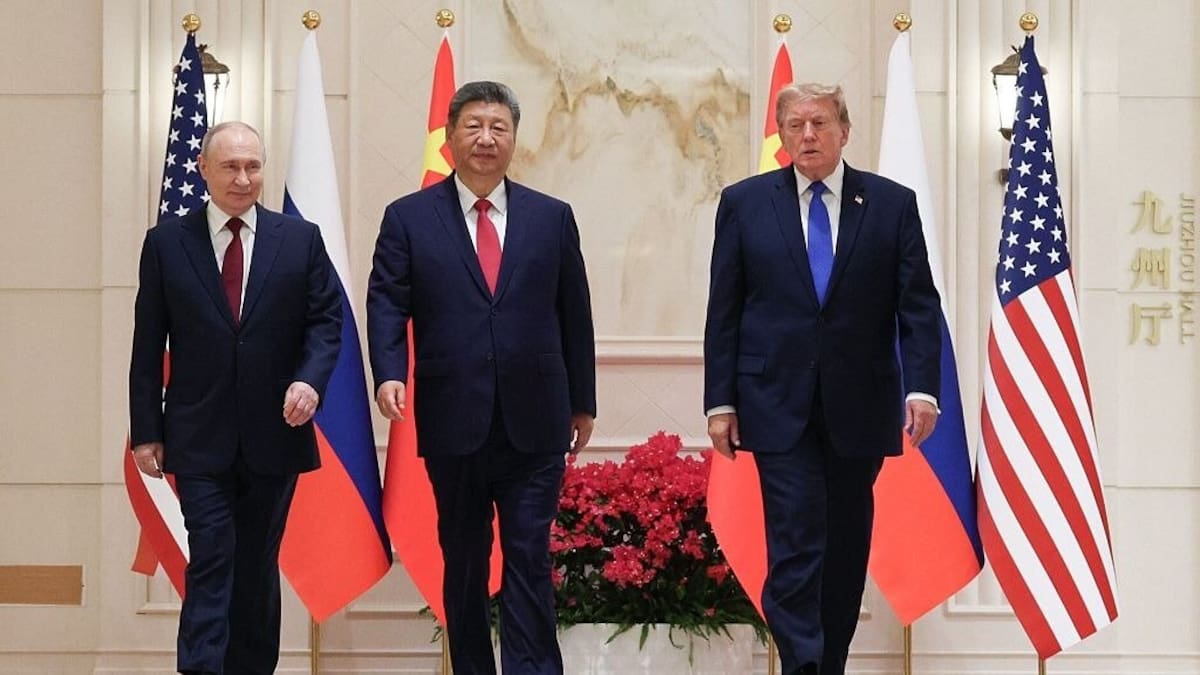
Donald Trump, Vladimir Putin and Xi Jinping clearly regarded their meeting in China as a triumphant personal vindication. Photo / Getty Images
As they gathered before a painting of the Great Wall of China, Presidents Donald Trump, Vladimir Putin and Xi Jinping clearly regarded the Shenzhen meeting as a triumphant personal vindication.
For Trump, this was the apotheosis of his brand of diplomacy, whereby his personal friendship with Xi and Putin might
resolve every problem and open a new era of peace, whatever the rest of the world might think.
For Xi, the meeting demonstrated China’s ability to convene the only world leaders whom he regards as peers – or near enough in the case of Putin – and urge them, without apparent irony, to “be good role models” and “make a greater contribution to the progress of humanity”.
As for Putin, the occasion was everything he could have wished for – visible proof that Russia under his leadership occupies the pinnacle of global power, dealing on supposedly equal terms with China and America, and confounding all attempts to punish him with diplomatic isolation for his onslaught against Ukraine.
All this explains the obvious self-satisfaction exuded by each leader in Kylin Villa, an opulent lakeside resort of the kind that Trump himself might have designed. Despite the harmony on the surface, however, each brought clashing objectives to their 90-minute meeting. So who wanted what? And who got what?
Advertise with NZME.
Advertise with NZME.
Xi Jinping
For Xi, the meeting demonstrated China’s ability to convene the only world leaders whom he regards as peers. Photo / Getty Images
What he wanted
Xi wanted the prestige of hosting a meeting that would inevitably be presented as the ultimate example of Great Power diplomacy in the Yalta tradition. As he chaired the gathering, Xi took the opportunity to regale a global audience with the finest tropes of Chinese diplomacy – apparently harmless generalisations, with no mention of any specific issue, but laden with hidden meaning.
“History is the best textbook,” announced Xi in his opening remarks, by which he meant that China’s history as a single nation goes back more than 2000 years, so you should all pay special attention or, better still, treat my pronouncements as your textbook.
“Changes not seen in a century are accelerating across the world,” added Xi, which was his way of saying that China’s power is growing with ever greater speed, while America is heading in the opposite direction.
Advertise with NZME.
“The three of us should be good role models,” he concluded, raising the question – which, in Xi’s mind, has one obvious answer – of which of the three is the best role model for the other two, and the rest of the world, to follow.
What he got
Xi got the acclaim of being the gracious host and a joint statement with Russia and the US, the first point of which reads: “As permanent members of the United Nations Security Council, China, Russia and the United States are committed to promoting United Nations reform so that it may respond more effectively to global challenges and fulfil its fundamental mission of maintaining international peace and security.”
In China’s eyes, that means the UN High Commissioner for Human Rights must never again reveal inconvenient truths about Xi’s atrocities. In 2022, the UN declared that China’s mass incarceration of millions of people from the Uyghur minority in Xinjiang province “may constitute international crimes, in particular crimes against humanity”. China will now claim the US’ support for stopping any repetition of that episode.
As for Trump’s once-vaunted tariffs, loathed by China for their impact on its exports, there was no mention of them either in the opening remarks or the joint statement.
Donald Trump
For Trump, the meeting was the apotheosis of his brand of diplomacy. Photo / Getty Images
What he wanted
Trump came to the meeting armed with more points of substance than either of his counterparts. He stressed how the countries at the table were the world’s “largest nuclear powers”, making them “uniquely positioned to discuss how to reduce the number of nuclear weapons on Earth”.
Advertise with NZME.
He wanted to “cooperate to combat the threat of nuclear proliferation in other countries around the world”, adding: “We’re not going to let Iran have a nuclear weapon.” Trump also referred to resolving the war in Ukraine and claimed that “things were moving”.
What he got
Trump’s problem is that his friend Xi is busily expanding China’s nuclear arsenal with astonishing speed, more than doubling the stockpile from 200 to over 500 warheads in three years from 2020 to 2023. Nothing is going to stop Xi from churning out even more nuclear weapons, at least until China achieves parity with the United States.
So the fourth point of the joint statement amounts to a meagre bone for Trump. “The three heads of state reaffirmed that a nuclear war cannot be won and must not be fought,” it declares, echoing familiar language that all three countries have signed up to before. “The three countries will engage in dialogue on reducing nuclear risks and preventing nuclear proliferation,” it added. But promising “dialogue” alone is almost meaningless, particularly as there was no mention of what Trump wants, which is nuclear arms reduction.
Vladimir Putin
For Putin, the meeting was everything he could have wished for. Photo / Getty Images
What he wanted
Putin wanted the symbolic victory of being treated on equal terms by Xi and Trump, even though Russia’s economy is less than a tenth of the size of America’s and barely an eighth of China’s.
Yet, Putin was also seeking points of substance. He wanted Trump to agree to a form of words opposing both energy sanctions on Russia, and Ukraine’s long-range strikes on the country’s energy infrastructure. Putin also wanted his counterparts to denounce the International Criminal Court (ICC