Welcome back, America! It’s your turn to be sorry
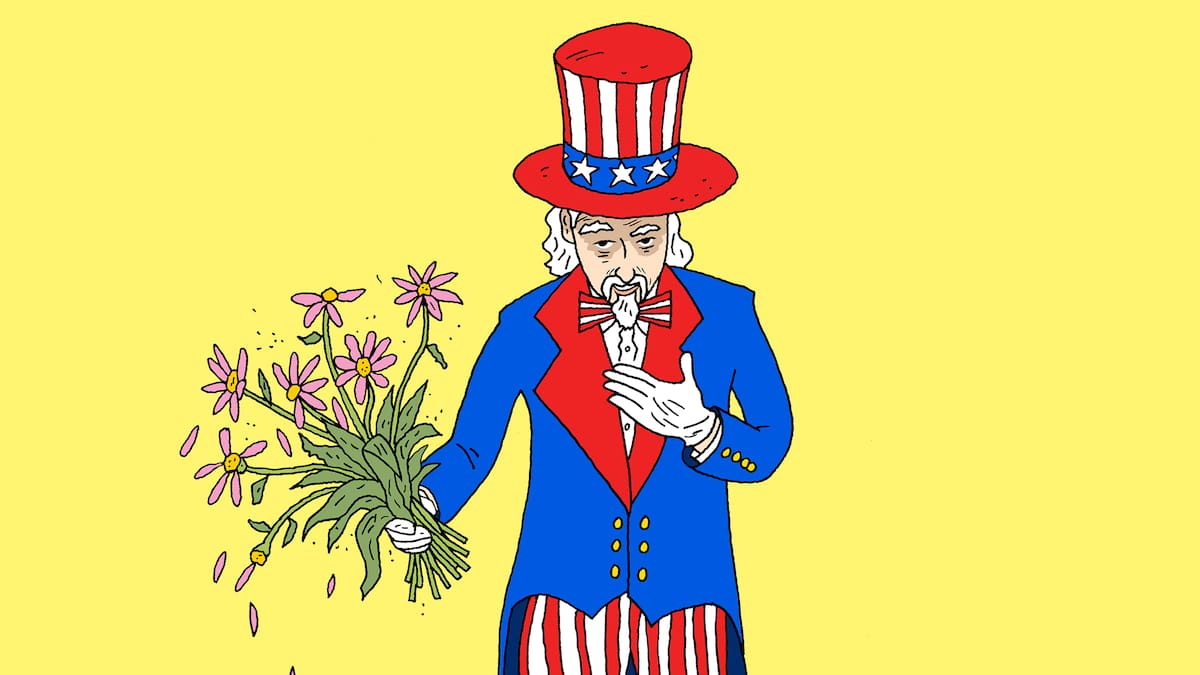
This month, the world’s most unreliable boyfriend began to redeem himself.
Earlier this year, when I was en route from Toronto to Boston, a security guard running the X-ray machine at Island Airport recognised me with a big smile and a warm greeting.
Then he got serious. I was in
the wing of the airport reserved for US travel, so he knew where I was headed. He didn’t approve.
“Minister, you know we’re not allowed to go there anymore,” he said.
I explained that I agreed with Canada’s very unofficial ban on nonessential US trips. Then I assured him I was flying south to make the case for our country, and to visit an institution whose resistance to illegal orders from the White House Canadians generally admire, to boot.
He was unconvinced. “Well, Minister,” he told me, “go talk to them if that’s what you need to do. But I hope you tell those sons of bitches that we’ll be better off without them, anyway.”
I’ve told this story a few times to US audiences. There is usually a collective intake of breath when I share the first line, about Canada’s de facto national boycott of discretionary US visits.
That turns to astonishment, and sometimes outright anger, when I recount the kicker.
Advertise with NZME.
But my friend at the luggage belt was articulating the national consensus in Canada. And it is not only Canadians who have been getting ready to write off America. For many Europeans, President Donald Trump’s recent betrayal of Ukraine has felt like the last straw, proof that America is on the wrong side in the most serious security threat the continent has faced since World War II.
Hans Petter Midttun, a former Norwegian defence attaché to Ukraine, put plainly what many of his colleagues still in government have been saying in meetings with me behind closed doors. “Like China, the US has sided with Russia against Ukraine and Europe,” he argued, going on to say that “the US is no longer an ally, but a strategic adversary”.
For a lot of Canadians, and citizens of the other democracies, even this month’s Democratic tsunami in the midterms won’t be enough to immediately change their minds about the reliability of the United States.
Trump knows me, and he doesn’t like me very much: He has called me a “nasty woman” and “toxic” and celebrated my resignation from Justin Trudeau’s cabinet by crowing, “She will not be missed!!!”
So my compatriots may be surprised to read my advice here that Canada and the world’s other democracies need to embrace the midterm results as an opportunity to start figuring out how to renew the global democratic alliance – including inviting Washington to rejoin us in a new, more balanced partnership. Crucially, this reimagined relationship needs to be different from what preceded it. Jean Chrétien, the former Canadian prime minister, likes to joke that Trump should be awarded the Order of Canada, because he prompted our country to do the hard work needed to be stronger and more independent at home. The same is true of the Trump effect in Europe and Asia. Thanks to those efforts, we are all now in a position to create a 21st century partnership, in which responsibilities and authority are more equally shared.
US President Donald Trump speaks to reporters at Joint Base Andrews in Maryland on October 28, 2026. Photo / Doug Mills, The New York Times
But I can’t deny it will be a hard sell.
My own, unreliable boyfriend metaphor for America’s fraught relationship with its allies has made it into the popular culture in the Great White North. The Beaverton, Canada’s version of The Onion, pretty accurately summed up the national mood this month with a riff on my conceit: “After a Democratic blue wave swept the US midterms tonight, and Democrats took back both the House and the Senate from the Republican Party, Canada wishes to gently, yet firmly, let all of America know that we will still not be taking you back.”
I don’t blame my compatriots for being sceptical. After all, they remember the giddy relief of Joe Biden’s victory in 2020 and how it was followed by the “just when you thought it was safe to get back in the water” nausea of Trump’s re-election in 2024.
Advertise with NZME.
The fact that Americans had freely chosen Donald Trump not just once, but twice, made it hard not to conclude that they actually agreed with the self-christened “Tariff Man” and his chest-beating commitment to America first. The great capitulation of corporations, law firms, universities and pretty much the entire Republican Party during Trump’s first two years in office in this second term seemed to be further proof that the problem wasn’t just Trump; it was America itself.
The seemingly inescapable conclusion was that America – and Americans – simply could no longer be trusted as an ally of the world’s democracies.
As Benjamin Haddad, then a member of the French National Assembly, cautioned in early 2024, months before Trump’s re-election: “We need to ask ourselves if we want to rely on the voters of Montana, Wisconsin and Michigan to keep Europe safe. Basically, Europe’s security would be flipping a coin every four years.”
But the break with America was about more than treaties and tariffs, more than reliability and betrayal. The world’s democracies started to give up on America because they thought America was giving up on democracy.
Abroad, America’s traditional friends saw Washington siding with dictators and undermining democracies. At home, they saw a Maga president muzzling universities and the free press, pressuring corporations to kowtow to him, and more, and unleashing masked agents who shot live ammunition at his citizens.
Supporters of Democratic US Senate candidate James Talarico cheer at an electio