Tom Phillips hunt: Netflix documentary crew filmed covert police tactics, review finds
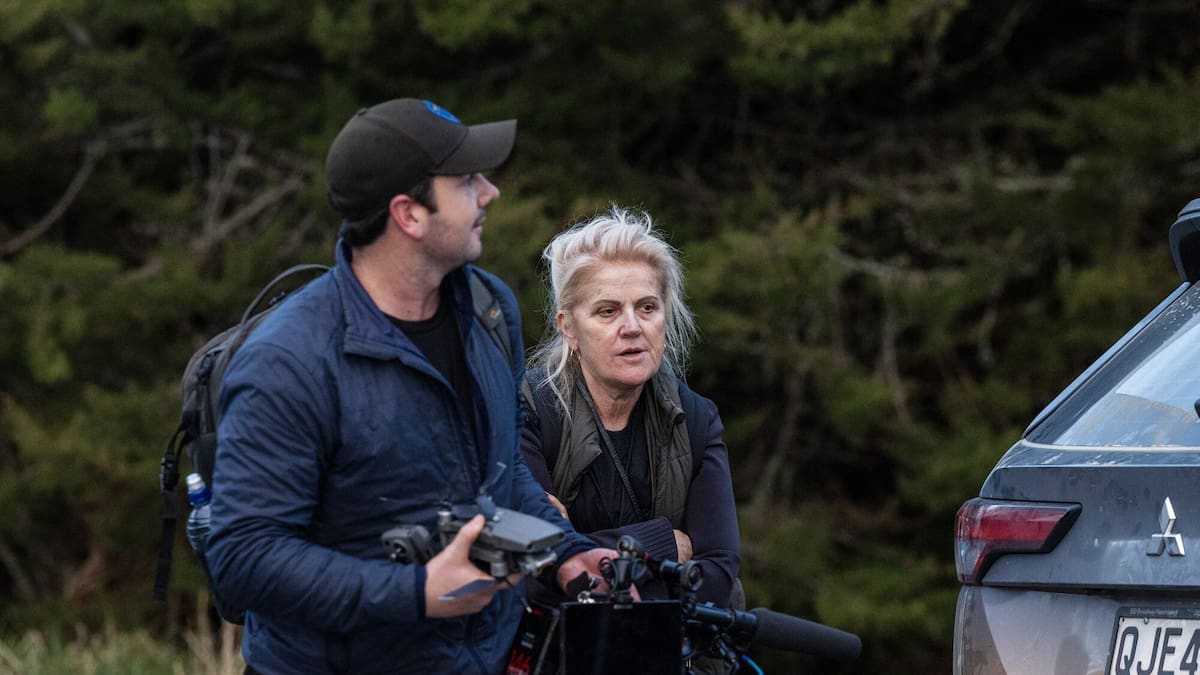
Dame Julie Christie and a cameraman at the scene of the Tom Phillips shooting. Photo / Mike Scott
A Netflix documentary crew filmed covert police tactics in the hunt for fugitive father Tom Phillips capturing intercepted conversations and motion-activated footage.
As the crew for a documentary led by Dame Julie Christie became more embedded with the investigation team the access given during investigation briefings extended to include “exposure
to discussion and practical utilisation of covert policing tactics”, according to a review released by police today into their collaboration with the documentary.
“During the interception phase, staff were filmed actively listening to intercepted communications. They also had access to the covert, motion-activated cameras and footage.”
Access also included operational briefings and live radio communications, and recording devices including microphones and cameras were seen in “proximity to personnel engaged in discussions that were not intended for capture”.
“As a result, members of the specialist units formally raised concerns regarding the breadth and nature of access afforded to the documentary production crew.”
Advertise with NZME.
Advertise with NZME.
The 90-minute to two-hour documentary with the working title The Marokopa Project is being produced for Netflix by Christie’s NHNZ Worldwide and UK-based Grain Media.
A campsite where fugitive father Tom Phillips is believed to have stayed. Photo / Police
No actual conflicts of interest were identified in how police managed mainstream media or the documentary production, with “no evidence police decision-making or operational activity was influenced by the presence of the film crew”, the review found.
But embedding a documentary production within an ongoing high-risk investigation did give rise to potential and perceived conflicts, including because an external film crew appeared inconsistent with the strict operational security covert operations needed, and because not granting mainstream media the same access created the “appearance of preferential treatment”.
Advertise with NZME.
Police officers in charge of the Tom Phillips shooting scene and campsite where he had been evading capture also formally challenged the documentary crew’s access but were told it was approved by top brass.
A camera operator followed the inquiry’s lead detective and several other officers as they worked to find the fugitive father.
The review reveals that the day after Phillips was killed in a shootout with police on Waitomo’s Te Anga Road, Christie and a cameraman were given ”privileged, controlled access” to the scene for 25-30 minutes.
Dame Julie Christie at the police checkpoint at Te Anga and Waipuna roads, near where fugitive Tom Phillips died. Photo / Michael Craig
Phillips’ body had been removed but not all forensic examinations were completed, the review said.
“Dame Julie Christie and a cameraman were permitted to attend and film from the northern side of Te Anga Road, an area that had been forensically processed. They were accompanied by the Officer in Charge of the Scene, who provided a recorded operational narrative. At the time of access, key elements to the scene remained in situ, including the ATV and police vehicles. Forensic evidence was present and visible within the scene at this time,” the review said.
Advertise with NZME.
The pair were also given access – under a police escort – to a campsite where Phillips’ children had been located. Exclusive access to the scene was authorised by Acting District Commander Andrea McBeth.
“At the time of access, the forensic examination had not been completed, and key elements of the scene remained in situ,” the review said.
Police vehicles near one of the Phillips campsites after the fugitive father was shot dead and his children located. Photo / Dean Purcell
The review also revealed that the officers in charge of both scenes challenged the documentary crew getting behind the cordons.
“Both Officers in Charge of their respective scenes were cognisant that granting such access to the documentary production was inconsistent with established best practice and had created additional scene-management risks that required careful control. Each officer formally challenged the decision to permit access; however, access was approved with communication [staff] emphasising that the agreement with the documentary crew was approved at a senior level,” the review said.
The access given to the doco crew had sparked controversy, including from media who questioned what they perceived as unfair treatment.
Advertise with NZME.
Police’s executive director of media and communications Cass Carter said some of what police could do better – “such as giving documentary staff access to crimes scenes” was already clear going into the review.
“I can assure people, right from the start, there were strict settings in place to protect the children and sensitive Police operational information.
“While the documentary did not compromise investigative integrity, we know there was a perceived conflict, and it did create conditions where integrity required protection. Some staff had reservations which they raised at the time,” Carter said.
“Our relationship with media was also called into question. That relationship is vital to the work we do every day. The media supports our ability to reach communities and get important safety messages and reassurance out to them.
“We agree that some of our decisions around the documentary meant we did not serve media in the way we should have. Police has a long history of cooperating on documentaries or programmes involving ongoing investigations, and we don’t want to stop that. They offer unique and interesting insights into Police work and transparency around our work, which enables communities to have trust and confidence in their Police.
“We just need to do better in how we manage these agreements, so we ensure we are being