There’s a new James Bond, again. How did the last ones fare?
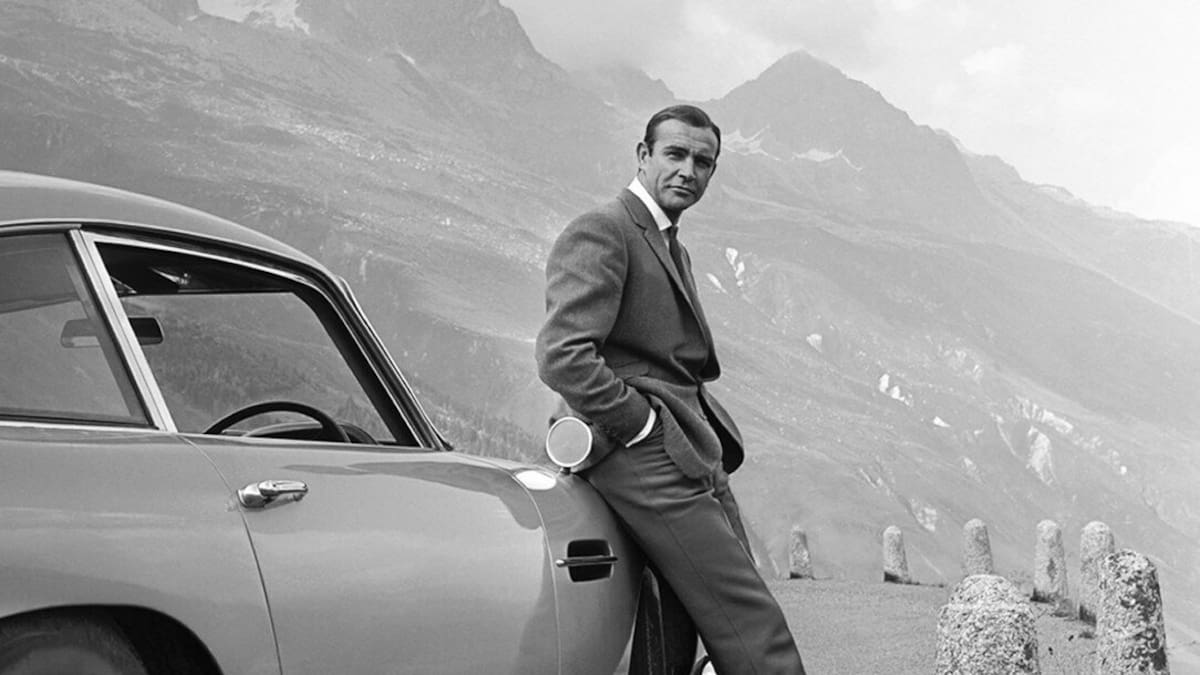
Sean Connery as James Bond, with the spy’s characteristic Aston Martin DB5, in Goldfinger.
The casting of 007 inevitably stokes debate, and the immediate reaction doesn’t necessarily match the eventual reviews.
Now that Robert Pattinson has been announced as the next James Bond, fans of the franchise will no doubt weigh in with their verdicts, sizing up the actor and
drawing firm conclusions before he even has the chance to make a first impression as 007.
It won’t be the first time. Opining about Bond casting is an age-old pastime, and each actor who has played the world-famous British spy has faced scepticism upon being thrust into this particular spotlight.
And some Bond traditionalists are also wary over what direction the films, based on the novels by Ian Fleming, will take now that the franchise is controlled by Amazon MGM, which has said that it plans to take the series in new paths.
But hasty complaints and lasting assessments aren’t always the same, and history has been kinder to most Bond stars than the hair-trigger reactions would have suggested.
Advertise with NZME.
Here’s a look back at how the New York Times has viewed the previous Bond actors when they were cast and after the films made it to the big screen.
Sean Connery
Before Fleming’s novel Dr. Nowas adapted for the screen, a London newspaper conducted its own search for the ideal actor to play the super spy, the New York Times recalled in a 1987 lookback for the film’s 25th anniversary. “A thousand readers sent suggestions, including a man named, appropriately enough, James Bond,” the article noted.
Sean Connery, the producers’ choice for the role, won Fleming’s approval, too: He described Connery, according to the Times, as “an absolute corker, a 30-year-old Shakespearean actor, ex-Navy boxing champion, etc., and even intelligent”.
Advertise with NZME.
Reviewing Dr. No,, Bosley Crowther praised the film as a “lively, amusing picture,”, and described Connery’s Bond as “an elegant fellow” who is “natty, naughty and nifty to the end”.
Years after Connery’s Bond era, which critic Caryn James recalled as “a time many still consider the Golden Age,”, she summarised Connery in the role as “smoother than a dry martini, faster than an Aston Martin, practically able to leap from tall buildings and land in a woman’s bed”.
George Lazenby
George Lazenby was new to film acting when he starred in On Her Majesty’s Secret Service.
Lazenby, who appeared in only one Bond adventure – On Her Majesty’s Secret Service(1969) – rarely gets much of a second thought.
In his review, critic A.H. Weiler was immediately dismissive of Lazenby, a former model and car salesman who was new to film acting. “He’s tall, dark, handsome and has a dimpled chin,” Weiler wrote. “But Mr Lazenby, if not a spurious Bond, is merely a casual, pleasant, satisfactory replacement.”
Fifty years later, the Timesnoted that the film had “won increasing respect” for its direction, script, music and “mastermind criminal scheme,” but even Lazenby expressed some regret. “At the time, I thought I did a good job,” he said. “Now I know I could do it better.”
Roger Moore
Roger Moore in Octopussy. The New York Times’ review described the 13th Bond instalment as “actually better than most.”
“The Saint is taking over as 007,” James F. Clarity proclaimed in the Timeswhen it was announced that Moore, the star of TV’s The Saint, had been named Connery’s successor. (Connery, the piece added, had abandoned the part after it “made him rich and bored”.)
But critic Roger Greenspun was left unimpressed by Live and Let Die, the eighth Bond instalment and the first starring Moore. In fact, it was Moore’s presence in particular that Greenspun objected to in his review for the Times, dismissing the actor as “handsome, suave, somewhat phlegmatic,” and with “a tendency to throw away his throwaway quips as the minor embarrassments that, alas, they usually are”.
Moore was the oldest Bond actor when he last reprised the role, inA View to a Kill (1985). He was 59, and the reviews were not kind. “The effort involved in keeping Roger Moore’s 007 impervious to age, changing times or sheer deja-vu seems overwhelming,” critic Janet Maslin wrote, deriding the movie as “a monumental chore”.
Advertise with NZME.
Timothy Dalton
Timothy Dalton in The Living Daylights, for which the New York Times review called him “well equipped for his new responsibilities.”
Dalton was first flagged as a potential Bond as early as 1969, but he declined on the grounds that he felt too young for the role. Nearly two decades later, he accepted the part.
A brief Reuters news item published in the Timesin 1986 noted that Dalton, “who was born in Wales and whose physique and accent fit the fictional mold of Mr Fleming’s dashing hero,” was a serious actor known for his theatre work. A Timesprofile of Dalton, published in the lead-up to his Bond debut and written by Benedict Nightingale, reiterated the point, describing the actor as “a bit of a paradox,” like Bond himself.
The Dalton films were a little edgier than their predecessors, and reviewers noted the absence of light comedy that had defined many of the Moore escapades. Caryn James called License to Kill, Dalton’s second Bond flick, “familiar,” but noted that “Mr Dalton’s presence adds a darker tone.”
Pierce Brosnan
Pierce Brosnan in GoldenEye.
Although Brosnan, best known at the time for Remington Steele, did not appear as Bond until 1995, he had professed in an interview a full decade earlier that he had aspirations of succeeding Moore in the role. When he eventually made his debut as Bond in GoldenEye, at age 43, he told the Times that he would “be a fool to tamper with what makes James Bond work”.
In her reviewing of GoldenEye, Janet Maslin called Brosnan “the best-mous