No skids, no burnouts: the car scene ditching ‘boy racer’ label
No skids, no burnouts: the car scene ditching ‘boy racer’ label
Thanks to decades of imports, the niche Japanese car scene is thriving in New Zealand - and trying to shed a bad reputation.
Serena Solomonand Isra'a Emhail
3 November 2026
8 min read
Serena Solomonand Isra'a Emhail
3 November 2026
8 min read
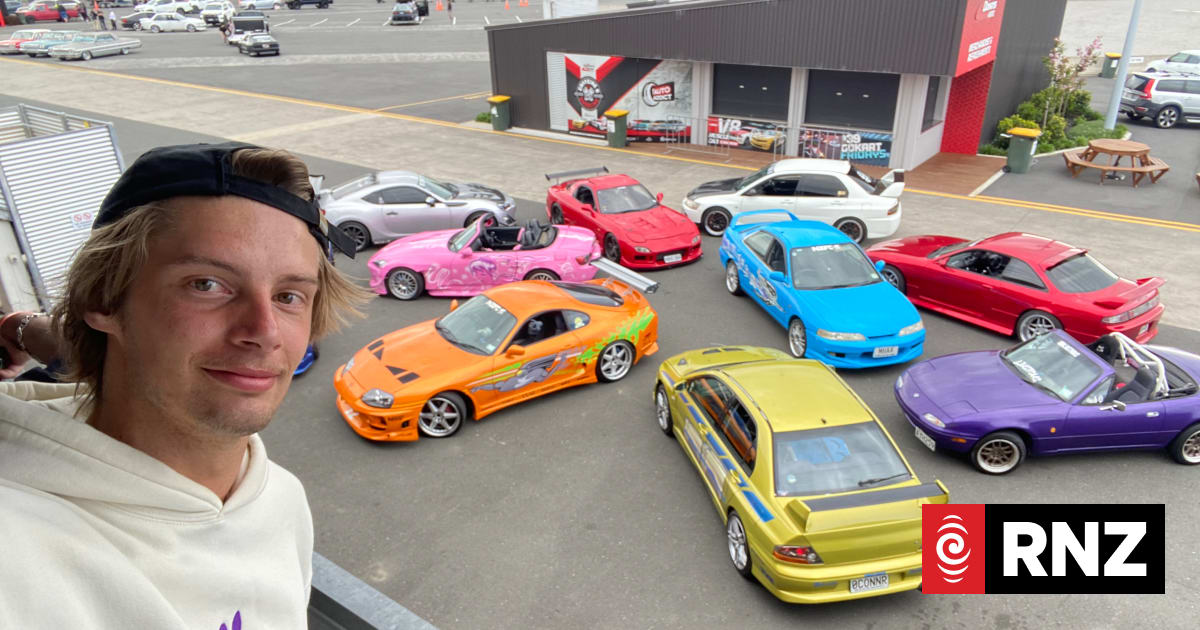
Caption:Jordan Christensen, a Japanese Domestic Market car podcaster, with some of the cars he and his friends drive.Photo credit:supplied
Many New Zealanders might know this feeling: You’re driving along when you hear the flutter and hiss of a turbo, the bang and roar of a modified exhaust.
Then you see them: a swarm of shiny Subaru WRXs, Nissan Skylines, Toyota Supras and Honda Civics. Each car is lovingly decked out in its own unique mix of spoilers, custom alloy wheels, bright paintwork and interior details (seatbelts, steering wheels and seat covers are all per the driver's taste). Some have coloured fluorescent lights under the bumper.
The one year anniversary meet and cruise of JDM South in September.
supplied
You sigh to yourself and think, ‘Oh damn. The boy racers are here’.
Well, 34-year-old Matt Jardine wants to change the way you think about these cars and their drivers.
Jardine has a deep love for Japanese domestic market (JDM) cars. Thanks to decades of Japanese imports, New Zealand has a thriving, world-class scene, where engines, body and interior are modified for ultimate self-expression. It leans heavily on nostalgia for 1990s and 2000s cars, before computerised systems made home modifications more difficult.
Enthusiasts admit that not every JDM driver is an angel on the road, but those interviewed by RNZ say they are unfairly perceived by the public and authorities as boy racers. Recent legislation has also targeted antisocial driving, including loud exhausts. Ahead of the recent election, the ACT Party promised a fleet of relocatable noise cameras for Auckland.
“A lot of people with, you know, their Skylines and all that sort of stuff that are tens of thousands of dollars, they don’t really want to go in and do skids or abuse them in that way now,” says Jardine.
Matt Jardine's 2008 Toyota Crown Majesta with factory airbag suspension, 20-inch rim wheels and aftermarket exhaust and body kit.
supplied
Tired of that misunderstanding, Jardine, based in Invercargill, started the car club JDM South a little over a year ago with about five. The one-year anniversary of the group in September had close to 120 cars come for a meet and cruise.
“Basically, people can just come along, park up, have a look at each other's cars, and it's in a safe, family-friendly environment.”
Auckland-based JDM podcaster Jordan Christensen, 23, is on a similar mission: to show off the wholesome side of the JDM car scene while documenting its history. Two recent episodes of the LT Podcast had about 3.5 million streams across various platforms, says Christensen. Location data shows listeners in New Zealand, the US and Australia.
He still remembers as a nine-year-old the moment he fell in love with JDM cars at a drift meet on a racetrack.
Jordan Christensen and his 1989 Mazda MX-5 that he restored and modified.
supplied
“There were these JDM cars with, you know, loud exhausts and excessive body kits and liveries [graphic paintwork].
“You could just smell the burning rubber. You could smell the fuel. You could just hear these exhausts going off, all these different motors.
“And that was when I was like ‘Oh, this is it. This is what I’ve been looking for’.”
Like many enthusiasts, Christensen’s JDM fascination was fuelled by the Fast & Furiousfilms, which helped popularise Japanese performance cars and modification culture.
The first Fast and Furious movie starring Vin Diesel and Paul Walker came out in 2001.
Universal Pictures
In the interviews he does for the LT Podcast, he has noticed how the JDM scene has changed since its infancy three decades ago, when you could get a Skyline for “dirt money”. There were also rivalries between those who drove the different car makes, like Mazda vs Subaru, says Christensen.
Now, some Skylines are selling on Trade Me for more than $200,000, and JDM enthusiasts come together over a shared appreciation, says Christensen.
Co-hosts of the LT Podcast, Andy Scarr (left) and Jordan Christensen (right).
supplied
Case in point was a recent meet at an Auckland car park that attracted hundreds of cars. It was jointly organised by Ollie West, 19, from Wellington Carz and StreetRushxNZ, which organises legal car meets in Auckland, Tauranga and Napier. The event was advertised with a “no skids, no burnout” rule.
Photographers lined the entry to the car park like paparazzi to photograph cars - a mix of European and JDM- as they drove in. The crowd was mostly young men with some women and a few families.
Deeia Awad, 27, drove his 1996 Toyota Soarer up from Wellington for the event, where a group of excited teenage boys peered into the car.
“You can open it, bro,” Awad tells them, as they take turns in the driver’s seat so they can get a feel for the car.
He pops the bonnet and talks specs, oil and prices. The car’s engine is modified to “just shy of 600 horsepower“, Awad says, which is what you typically find in a luxury sports car. Like others interviewed by RNZ, he pays to use a racetrack rather than a public road when he wants to test his car’s power.
Some of the cars at a recent meet in Auckland jointly organised by Wellington Carz and StreetRushxNZ.
Bigboy_media
While attendees at the meet appeared to stick to the no-skids or burnout rule, the cacophony of car engines revving and exhausts popping was deafening. Police confirmed organisers had notified them
Source: https://www.rnz.co.nz/life/culture/not-just-boy-racers-inside-nz-s-japanese-car-scene