New Zealand would have supported collapsed climate deal, minister says
23 November 2026, 1:14pm
New Zealand would have supported collapsed climate deal, minister says
Kate Newton
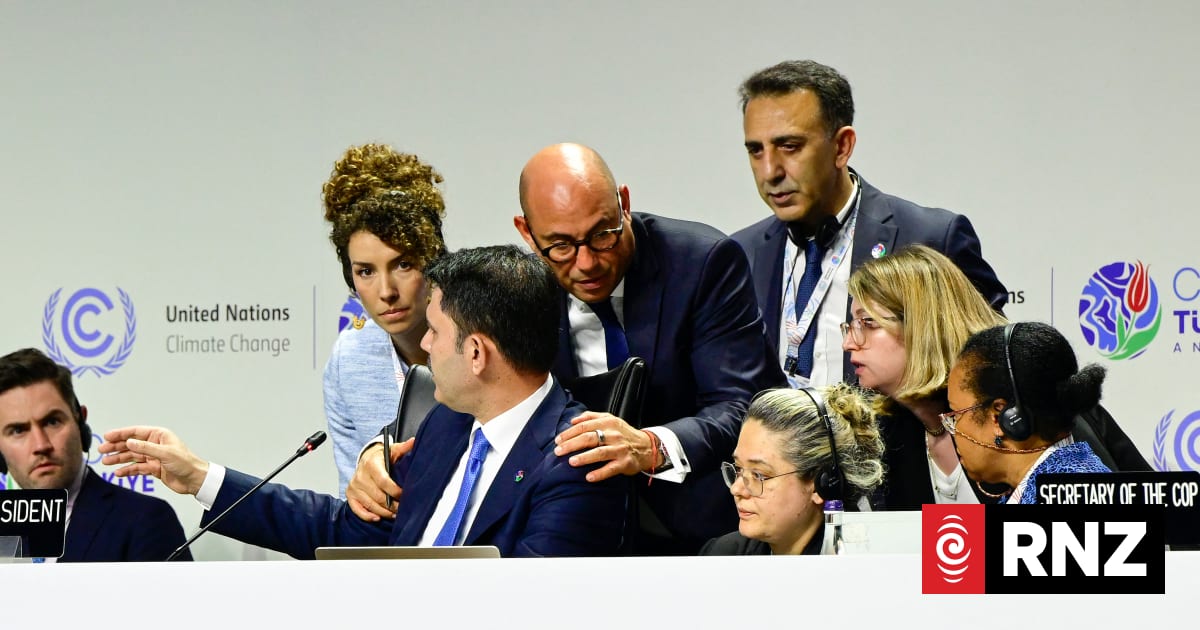
Caption:United Nations Climate Change executive secretary Simon Stiell speaks with COP31 President and Turkey's Minister of Environment, Urbanisation and Climate Change Murat Kurum during a plenary session of the United Nations Climate Change Conference.Photo credit:YASIN AKGUL
New Zealand was ready to support a draft deal that prompted UN climate talks to collapse without a decision.
COP31 ended on Monday in Antalya, Türkiye, with no consensus after more than two weeks of fraught negotiations.
The final draft deal, known as a cover decision, avoided any mention of the fossil fuels driving global warming.
The European Union, together with Panama and several other countries, formally objected to the draft, saying it was "unconscionable" to support it.
A spokesperson for New Zealand's caretaker climate minister, Simon Watts, said New Zealand was "ready to support a consensus on the cover decision".
Asked to confirm if that meant New Zealand supported the final draft as it stood, the spokesperson said: "Yes - New Zealand would have supported consensus in the room."
Despite the lack of a decision, the conference - which Watts attended for three days last week - was "a valuable opportunity for New Zealand to engage internationally and strengthen important relationships", the spokesperson said.
Green MP Francisco Hernandez, who was at COP31 until this morning NZT, said the EU and others were right to reject the draft decision.
The lack of any language about a transition away from fossil fuels was especially disappointing, he said.
"That was probably the most egregious thing for us - not naming fossil fuel as the thing that's causing climate change is basically like going to a cancer conference and not acknowledging smoking as the cause of lung cancer," he said.
"It's a clear disconnection from the reality on the ground."
The final moments of COP31.
UN Climate Change / Kiara worth
The language about finance to assist vulnerable countries to adapt to climate change was also too weak, he said.
"There were some positive things in the text - things like the electrification target of 35 percent by 2035 - but unfortunately there was no real language there that it had to be clean energy."
The EU and others were right to walk away from the deal, he said.
"The draft text was just so weak - it doesn't meet the moment."
There were rumours all weekend that the deal would not pass, and a "febrile" atmosphere among the negotiating teams.
The failure to agree in a cover decision did not mean COP31 itself had failed, he said.
"I think people would be remiss to come away ... with the impression that we need to do less on climate, not more... This COP failed because it wasn't ambitious enough."
However, there was "probably merit" in considering whether the format of climate COPs - particularly the requirement for consensus decision-making - needed a second look.
"It really doesn't make sense to allow a small group of fossil fuel producers to hold the rest of the world hostage... Saudi Arabia was quite aggressive in trying to block progress on any of the texts."
'The issue hasn't gone away'
Otago University climate and energy researcher Sebastian Gehricke said he had paid less attention to the annual talks in recent years because of how frustrating he found them.
"The word 'fossil fuels' in itself has been a hot topic, and that seems farcical to me because that's the whole point - the key driver of mitigating climate change is to reduce use of fossil fuels."
Even when the talks did result in deals or goals being set, there was a lack of follow-through.
"You look at the climate finance pledge, where developed nations promised to provide financing for climate projects for adaptation and mitigation of US$100 billion per year, and that was never hit.
"Then they upped the promise to $300 billion, which also seemed silly because they'd never met the [first] goal."
In earlier years, the climate COPs had led to important developments, such as the Paris Agreement and Kyoto Protocol.
"But in recent years we haven't had such significant collaboration."
He believed that geopolitical swings to the right, combined with other global concerns such as multiple major conflicts and the cost of living crisis, had drawn attention away from climate change.
"The issue hasn't gone away ... but the political will behind it or the empowerment of leaders behind that momentum has decreased a lot."
However, the annual climate COPs were still "the best we've got" to address the threat of global warming, Gehricke said.
"There's certainly ways to improve that process a lot, and that's what we have to try to do.
"Because if more and more countries decided not to engage with it anymore then there is nothing - there is no other global collaboration between countries on climate change."
23 November 2026, 1:14pm