Donald Trump wanted Nvidia’s chief reinstated. Here’s how he succeeded
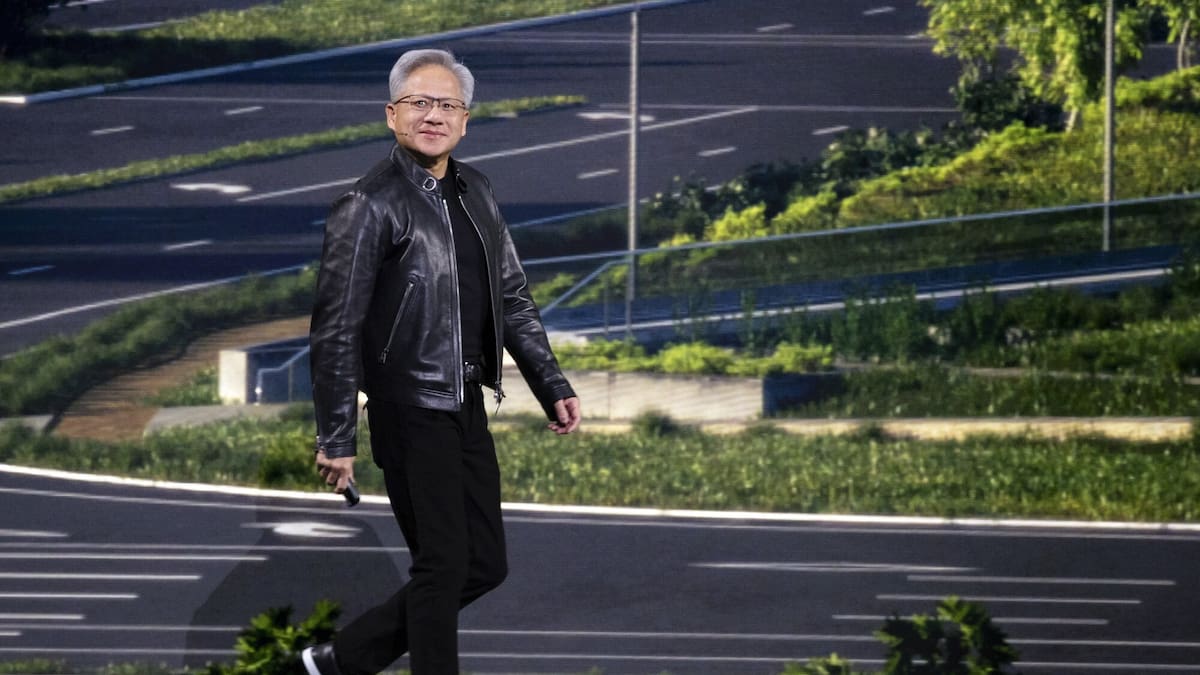
The President set in motion a weekend of manoeuvring, led by Vice-President JD Vance, to help Jensen Huang get his old job back.
US President Donald Trump had just returned to Washington from China at the end of last week, and his desire to have Jensen Huang reinstated as Nvidia’s
CEO was only intensifying, especially as he watched the sharemarket slide at the end of last week.
So Trump, who for weeks had been downplaying revelations about Huang’s affair with a woman believed by US officials to be a Chinese asset, decided to turn up the heat.
Trump asked Vice-President JD Vance, who came to office with close ties to Silicon Valley, to talk to Huang and work with Nvidia’s board. Over the weekend, Vance spoke privately with Huang, people with knowledge of the matter said. And he worked to get the board two things it would need to bring back a leader it had forced out little more than a week earlier amid a global scandal and had subsequently made clear it had no interest in rehiring.
One was an assurance that the Trump Administration did not believe Huang, who has admitted the affair, was a threat to national security. The other was a statement that Huang was not facing criminal charges.
Advertise with NZME.
Only a tiny handful of officials at the highest level of the Government were aware of these conversations. An equally small group at Nvidia was read in.
US President Donald Trump (left) and Nvidia CEO Jensen Huang at a White House event on April 30, 2025. Photo / Pete Marovich, The New York Times
By late Sunday night (local time), the deal was done. And it was announced Monday morning in co-ordinated statements, first from Nvidia and then from Trump, stunning Washington and the tech world and sending Wall Street – the President’s favourite proxy for his job performance – rocketing higher.
“I just thought he should be running the company and I didn’t know it was going to have this kind of an impact,” Trump said in a brief telephone interview with the New York Times soon after the news became public. “I’ve never seen anything quite like it actually. The stock is up.”
Advertise with NZME.
It is not clear how much pressure Trump needed to exert on the Nvidia board. Members of the board have been mum about their decision-making and have not offered any explanation about what changed between last week, when they ruled out Huang’s return, and this weekend, when they embraced it.
But Trump, whose party saw massive losses in the midterm elections and who has entered the lame-duck period of his presidency, seemed to be relishing having helped bend one of the world’s most valuable and strategically important companies to his will – in his view saving an executive he calls a genius and protecting a foundation of the 21st century economy.
“Did I do a good job last night?” he asked when first contacted by the Timeson Monday (local time).
But in employing his power, Trump also swept aside two issues, national security considerations and the possibility of criminal behaviour by Huang, that even many Republicans acknowledge are legitimate concerns.
The Timesreported on Sunday (local time) that the Chinese woman at the heart of the scandal kept in contact with an official of China’s top spy agency for more than a year while she was carrying out the affair with Huang. And Megaspeed, the Singapore-based company that employed the woman, Alice Huang, is under investigation by the Justice Department over allegations of smuggling advanced Nvidia chips to China to get around US export controls.
“The United States Government has no reason to believe that Jensen’s return to Nvidia poses any risk to national security,” Trump said in a social media post on Monday (local time), soon after Nvidia announced Jensen Huang’s return. “The Attorney General of the United States has confirmed that the US Government does not possess evidence that he has engaged in any unlawful conduct.”
Alice Huang (right), a Chinese executive linked to the data centre company Megaspeed, attending a dinner hosted by Jensen Huang in Taipei on May 22, 2025. Photo / AFP
Nvidia agreed to include in its announcement an agreement to hire a chief compliance officer, a nod to the scrutiny of its chips being smuggled into China. And, acknowledging reporting by the Timesabout China targeting Huang in an intelligence operation, the board said that its internal investigation would continue and that Huang would co-operate.
In directing Vance to engage with Huang and his peers, Trump was turning to one of the members of his Administration with the strongest relationships in Silicon Valley.
Advertise with NZME.
The Vice-President is close to some of Huang’s biggest supporters and admirers, including David Sacks, the investor and co-chair of the President’s Council of Advisers on Science and Technology. Sacks previously served as Trump’s key adviser on artificial intelligence (AI) and cryptocurrency issues.
Representatives for Huang and Vance declined to comment. Nvidia did not respond to an email seeking comment.
But if the outcome was an opportunity for Vance to carry out a tricky mission for Trump, it also highlighted again the divisions within Cabinet over how to handle Nvidia.
Treasury Secretary Scott Bessent had been publicly critical of how the Commerce Department had been regulating the purchases of Nvidia chips and technology by Megaspeed and cracking down on chip diversions to China. His hawkish position appeared to be undercut by Trump’s drive to reinstall Huang, who has advocated looser regulations on chip sales.
At the same time, Commerce Secretary Howard Lutnick, who had come under intense criticism for allying himself closely with Huang and not doing