Debt problems of the richest countries are trickling down to the poorest
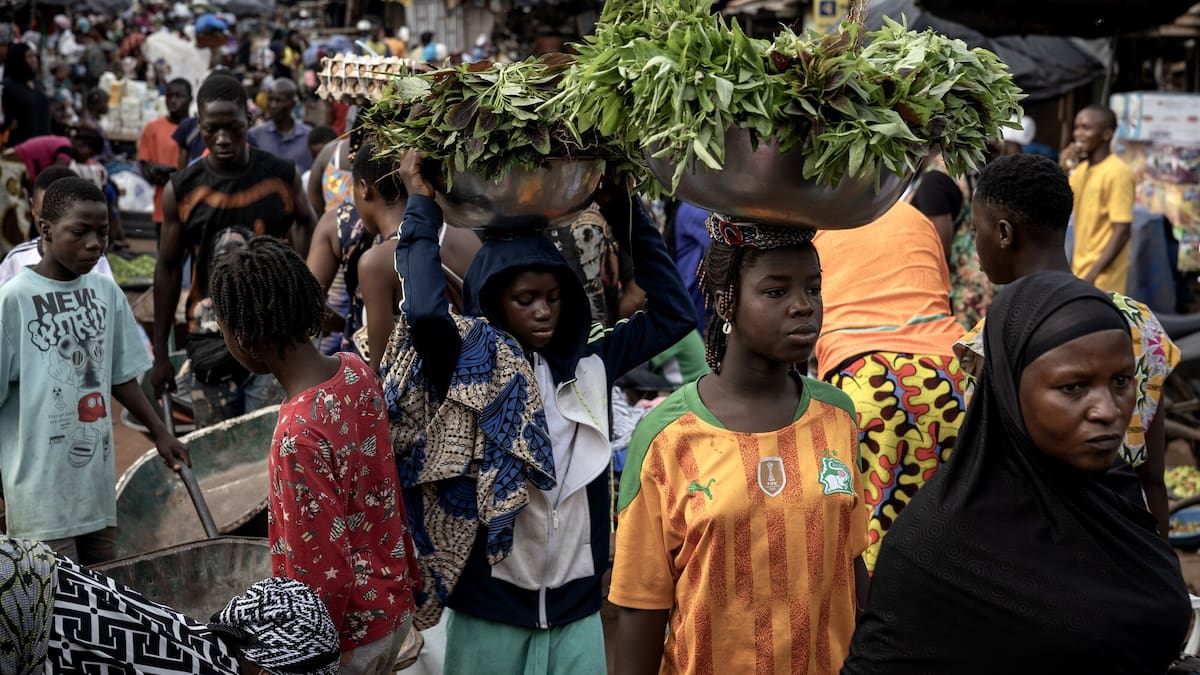
A market in Daloa, western Ivory Coast. Ivory Coast, Kenya and Nigeria have pledged annual interest rates of 7.5 to more than 10 percent to lenders. Photo / Finbarr O'Reilly, The New York Times
The debt load of developing countries jumped to $16.9 trillion as high interest rates and other global shocks batter their economies.
It’s hard to find a Government these days that is not struggling with crushing public debt.
The financial problems of wealthier nations have been monopolising the spotlight. The United
States, Britain, France, Italy, China and Japan are all facing record or near-record debt levels. The fallout has been painfully visible in France, where anger at rising costs and crumbling public facilities and services helped provoke violent protests and a general strike in recent weeks.
But rich countries’ fiscal problems do not just pool at home; they trickle down to amplify the financial pressures on low and middle-income countries.
The result is that less well-off nations are borrowing more and paying more for their loans. Their combined debt surged last year to US$9.4 trillion ($16.9t), according to a World Bank report this month.
Advertise with NZME.
The poorest of the poor countries fare the worst: they are facing interest rates not seen since the late 1980s.
Many of the causes are beyond their control. A series of crises, beginning with the Covid-19 pandemic, and continuing with energy shocks, supply chain disruptions and rising prices stemming from the wars in Ukraine and Iran have strained national budgets and pumped up debts.
Surging inflation pushed central banks to raise interest rates, which in turn has contributed to higher borrowing costs around the world.
Advertise with NZME.
“Debts that previously looked completely reasonable suddenly were carrying interest burdens that were well in excess of what a developing country can really afford to be paying,” said Christina Segal-Knowles, managing director for international policy at the Rockefeller Foundation. “That has led many countries to get in a really pernicious cycle.”
Big debts in wealthier nations are also affecting countries lower down the income ladder. Bond yields – the returns paid to buyers of government debt – are surging around the world. Private investors, increasingly worried about ballooning deficits and other challenges, are demanding to be paid more for taking on the risk of lending even to wealthy countries when they fear political leaders are shirking hard financial choices.
The US bond market – the world’s largest and most consequential – helps drive what happens elsewhere. US Treasurys are widely considered the safest in the world. But a federal debt of more than US$40t, roughly 120% of the size of the American economy, has aroused concerns.
Mounting deficits and the Administration’s policies have helped push yields on US Treasurys past 5%, reaching levels not seen in two decades. In France, bond yields are at a 25-year high, while Japanese bond yields are trading at their highest levels in three decades.
In turn, lower and middle-income countries, whose economies are nowhere near as strong as the United States, must offer even heftier premiums to compete.
The Ivory Coast, Kenya and Nigeria, for example, have had to promise lenders annual interest rates ranging from 7.5% to more than 10%.
Paying so much money to borrow is often necessary in the short term but self-defeating in the long run. Growth levels in these countries are unlikely to generate enough income to be able to pay off these loans.
Borrowing from institutions like the International Monetary Fund has also become more expensive for all but the poorest countries. That’s because the rates offered by the fund are based on interest rates set by key central banks.
Advertise with NZME.
“You see how the actions of the central banks of the advanced economies determine the cost of borrowing,” said Martin Guzman, a professor at Columbia University and a former economics minister of Argentina. “Ecuador has nothing to do with the war in Ukraine or Iran, but somehow they end up paying a higher interest rate to the IMF.”
And the Federal Reserve and other major central banks are expected to remain under pressure to raise rates further.
The US bond market, the world’s largest and most influential, helps drive global markets. But federal debt of about 120% of the economy is raising concerns. Photo / Karsten Moran, The New York Times
The high cost of repaying existing loans and accessing new ones is constricting political leaders’ ability to govern, regardless of their ideological bent. With so much money being redirected to pay down debts, there is less and less available to pay for education, healthcare, pensions, infrastructure, economic development and more.
In Egypt, Pakistan and Tunisia, more money is flowing out of the countries to cover debt and interest payments than they are receiving in loans, Guzman said.
Fifty-one countries, home to 3.7 billion people, spend more on interest payments than on healthcare or education, according to the United Nations Trade and Development.
At the same time, foreign aid and low-interest loans from advanced economies and multilateral development banks have dried up. China, which went on a lending binge in the 2010s, is now more focused on collecting money than on handing it out.
Mavis Owusu-Gyamfi, president and CEO of the African Center for Economic Transformation, underscored the need for joint action.
“China is a big player in this game and until we can reach a consensus with them,” she said, “every single debt negotiation is going to be in bits and pieces and is going to take a long time.”
What’s particularly frustrating is that money designated to promote growth is being siphoned off. Countries that receive lower-interest loans from international financial institutions such as the World Bank or regional development banks end up using some of that money to repay private lende