Arts Legends Aotearoa: Celebrating 25 years of the Arts Foundation Laureates
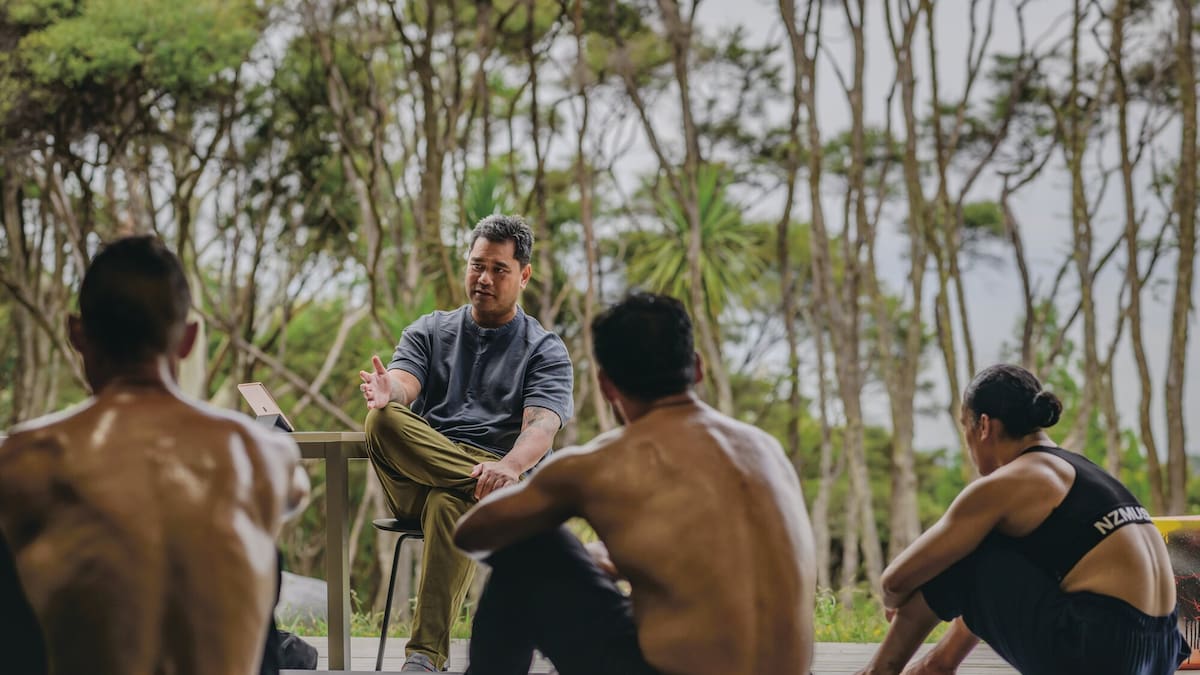
Neil Ieremia, Black Grace. Photo / Jinki Cambronero.
It’s been 25 years since a group of arts philanthropists came together to create The Arts Foundation Te Tumu Toi, a fund dedicated to supporting arts practitioners in Aotearoa. In an extract fromArts Legends Aotearoa: Celebrating 25 Years of The Arts Foundation Te Tumu Toi Laureates, we look atthree of 145 incredible Kiwis featured.
Neil Ieremia
By Sarah Daniell
The boy from Porirua had fallen arches and a broken heart. Rheumatic fever, diagnosed at the age of seven, would compromise for life his heart valve but not his dreams. Neil Ieremia (b. 1970) would take those feet, that heart and those dreams and navigate his way far from the binding shores, both literal and metaphorical, to create a singular artistic world that defied expectations and, at times, gravity. ‘Give me a child until he is seven and I will show you the man,’ said Aristotle. The boy from Cannons Creek said: ‘Wanna see my Bruce Lee moves?’.
The skinny little kid who took up martial arts to rehabilitate hints at the essence of the tenacious man he would become, and at Black Grace’s underlying bedrock of grit and resilience. Founded by Ieremia in 1995, acclaimed dance company Black Grace is both the personal and the political. The whole messy experience of life, says Ieremia — ‘all the scars’ — informs the movements, the intention, the discipline. The company, which celebrated its 30-year anniversary in 2025, has a rich legacy of challenging cultural and artistic traditions: the tearing of creative muscle for growth.
Advertise with NZME.
First, Black Grace was a company of 10 Pasifika and Māori men: a devout Christian, drag queens, a Cannons Creek street rocker, an ex-soldier, a country music lover, an aerobics champion and a Mormon. ‘It didn’t make sense,’ says Ieremia. ‘But somehow it worked.’ The company now includes wāhine and Pākehā/Palagi dancers, and more than 10 times the initial intake have now trained under Ieremia’s leadership. His reputation as a choreographer is formidable. The bar is high, the pace relentless. The experience for the audience is visceral. The exhilarating, streetwise works are internationally acclaimed.
Ieremia left home for Tāmaki Makaurau Auckland at 19. At a Karangahape Road studio, he was a fish out of water, with no classical training and no dance tights. On his first day, he was told to come back when he had the appropriate attire. A year later, he was asked to join the legendary Douglas Wright Dance Company.
‘I was a dancer for a long time and taught by choreographers, and there’s a difference,’ he says. ‘I make what I want to do and experience as a dancer.’ A complex deep thinker who loathes small talk, Ieremia is ‘in a constant state of reconciliation with myself ... I grew up in Cannons Creek without a lot of money. We certainly didn’t have theatre, or that experience of going to the ballet and what have you. I’m in the business of putting on shows that a lot of my community wouldn’t necessarily see, so we figure out these crafty ways of getting people in.’
‘Crafty’ in the style of Robin Hood: take from deep-pocketed philanthropists; give to kids in low-decile schools. ‘At that moment in the theatre when they see it and go, “I want to dance”, they can go out and change, move the dial for their family, challenge the stereotypes and gender roles within the culture, and that’s cool,’ Ieremia says.
Advertise with NZME.
He also says that Black Grace is not about him. ‘It’s not about the company necessarily. There’s a bigger “us” who benefits from it.’ Ieremia delivered a poem before the 2025 opening of If Ever There Was a Time. If ever there was a manifesto to his people, to art and life, and to the Samoan mother wanting help for her boy in a hospital in the 1970s and who got a terrifying diagnosis from eye-rolling doctors, it is this:
I believe this to my core, and I know that you do too,
One day we’ll all soar
High above the future that they see for us
And we’ll stop being sore and we’ll stop being poor
And we’ll stop being navigators
Who never leave the shore.
Roseanne Liang, Arts Laureate 2025. Photo: Devon Wycoff.
Roseanne Liang
By Shuchi Kothari
Advertise with NZME.
She has directed Alexander Skarsgård as a rebellious robot (Murderbot, 2025), put Chloë Grace Moretz into the ball-turret bubble of a B-17 Flying Fortress (Shadow in The Cloud, 2020), been attached to projects with Angelina Jolie and Halle Berry, won the Audience Award at the Sundance Film Festival, and made it to Hollywood’s much-coveted Alice Initiative list, which highlights top women directors ready to helm a large studio film. As an Asian New Zealand woman and mother of two children, living far from where the chimneys are smoking, filmmaker Roseanne Liang has not only defied the odds but also kicked them through the glass ceiling.
Well before she made her first short film, Roseanne knew this medium was her magic. Watching American blockbusters — Ghostbusters, Star Wars, Indiana Jones — with the buttery smell of theatre popcorn on her fingertips, enjoying uninterrupted time with her father in the cinema, is an enduring childhood memory. The joy and ritual of moviegoing seeded her long relationship with cinema. As a teenager, Roseanne was convinced that movies were the best animators of empathy, and that cinematic storytelling’s power to activate imagination was unrivalled.
When Roseanne pivoted from medical school to study film at Waipapa Taumata Rau University of Auckland, the medical world’s loss became the screen industry’s gain. She has always credited her education for her foundational creative practice and engagement with the larger historical and socio-political contexts of filmmaking.
Even at a young age, Roseanne’s command over action, comedy and dance was evident in the sketches she wrote and directed for A Thousand Apologies (2008), Aotearoa New Zealand’s first Asian-pr