Micro-tunnelling begins on Auckland wastewater tunnel
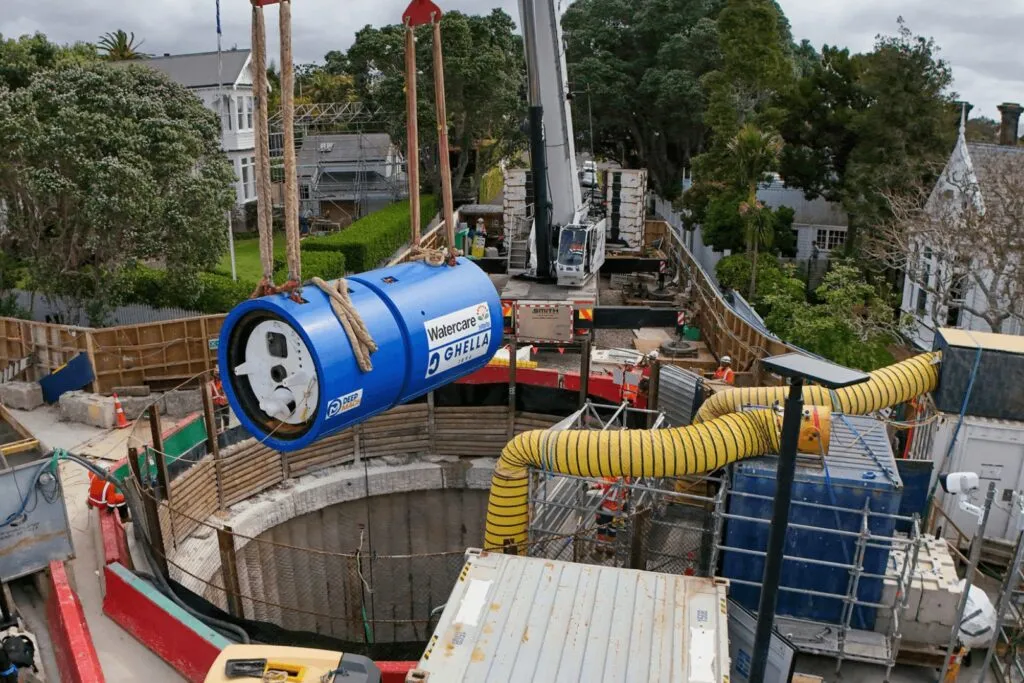
Utility company Watercare and tunnelling contractor Ghella have begun work on the first of seven sections of the NZ$260M (£109M) Herne Bay Collector wastewater tunnel in Auckland, New Zealand, with the launch of micro-tunnel boring machine (mTBM) Domenica.
The 1.7km long, 2.1m diameter Herne Bay Collector is a key part of utility company Watercare’s NZ$1.6bn (£668M) Waitematā Water Quality Improvement Programme. It will connect to the Central Interceptor, Auckland’s “super sewer”, which became fully operational in July 2026.
Just over a week ago, the Herne Bay Collector reached a key milestone, with the start of pipe-jacking operations. The earth pressure balance mTBM Domenica is advancing the first and longest drive of the project, tunnelling 626m beneath Sarsfield Street before arriving at the Point Erin Park site mid-next year. There are seven sections altogether, and tunnelling will take place between 9m and 22m below ground.
The tunnelling milestone follows the installation of a 56.5m tower crane to support construction of the project’s underground control chamber.
Watercare is delivering the project in partnership with Ghella, which worked on the Central Interceptor as part of the Ghella Abergeldie joint venture. While the main Central Interceptor tunnel was excavated using the larger, almost 200m-long Hiwa-i-te Rangi TBM, mTBM Domenica was also used to construct link sewers on the project.
Ghella New Zealand country director Rosario Barresi said: “Delivering complex underground infrastructure for Watercare and for Auckland, in such a constrained residential environment, with homes just metres from our sites, has required exceptional planning, precision and teamwork.”
Watercare chief infrastructure officer Mark Crowle said the use of micro-tunnelling technology helps minimise disruption for the local community.
“We know construction can be disruptive, and we don’t underestimate the impact that can have on neighbours,” he noted. “The advantage of micro-tunnelling is that we can carry out most of the work underground from a series of shaft sites, rather than needing to excavate a continuous trench through Herne Bay’s streets. That significantly reduces the amount of surface disruption required to install the tunnel.”
In addition to micro-tunnelling, Ghella will also employ a nano-TBM, horizontal directional drilling and hand excavation techniques.
Once complete, the Herne Bay Collector will capture wet weather flows from Herne Bay’s combined wastewater and stormwater network and divert them to the Central Interceptor for treatment at the Māngere Wastewater Treatment Plant.
Loading…
The Waitematā Water Quality Improvement Programme is one of nine work programmes in Watercare’s NZ$15.2bn (£6.3bn) 10-year capital investment programme, which includes more than 1,000 projects. As part of the latter, Watercare is now seeking expressions of interest domestically and abroad, for contractors to deliver the Motions Wastewater Catchment Improvements Project and Avondale Collector Project. The first project will deliver a 3.2km wastewater tunnel with an additional 1.7km of connection pipes linking the Motions catchment to the Central Interceptor at Western Springs, while a second one will deliver a 2.35km wastewater tunnel and 650m of connection pipes to divert flows to the Central Interceptor.
Auckland Central Interceptor Ghella Herne Bay Collector MTBM New Zealand tunnelling Waitematā Water Quality Improvement Programme Watercare 2026-11-17
Share