Caught on camera: Auckland’s hybrid electric ferry making a racket, again
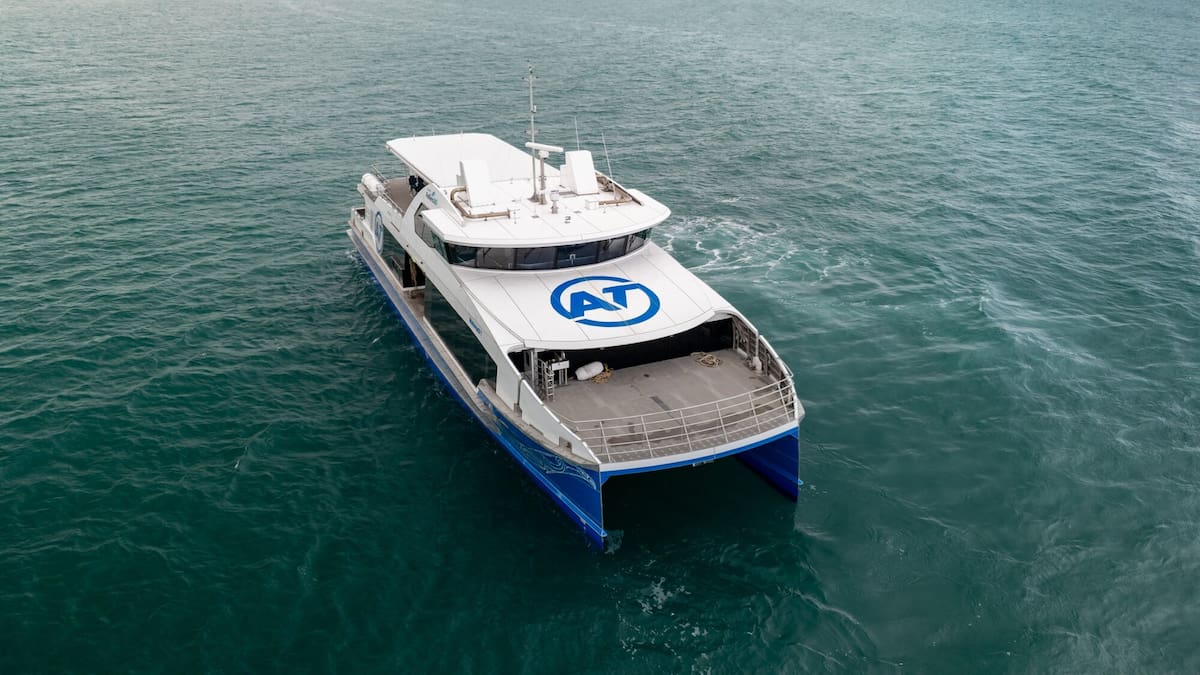
The good news: Birkenhead and Northcote residents are now less annoyed by Auckland’s first electric ferry making a racket as it charges from on-board diesel generators – a noisy contingency necessitated by the fact that mega-chargers on Queen’s Wharf won’t be completed until mid-2027.
The bad news: it’s migrated to
the other side of the harbour.
“Guess what. The ferry is now parking-up just off Judges Bay in front of the Parnell Baths, doing the same thing, engines running loudly, going nowhere,” Brian Cadzow told the Herald.
Advertise with NZME.
The charging was taking place about 800m from Cadzow’s home.
“It’s loud enough to be unpleasant. If we’re out on our deck, we come back inside.”
It had been happening for several days before Cadzow took a video (see top of article) on Sunday at 6.43pm.
He called it a “nice evening serenade”.
“If you hear some traffic noise at the end of the clip, it is a group of Samoan rugby league fans in their cars just coming on to Tamaki Drive past the port with flags waving and music blaring.” (It was November 8, the day of the Samoa v Australia Rugby League World Cup semi-final across the Tasman.)
Advertise with NZME.
The group can just be heard over the ferry.
“This is a massive waste of resources and diesel and annoyed residents who are having to put up with the noise,” Cadzow said.
Why not charge further from residents?
Why not fire the generators further out?
“The geography of the Waitematā Harbour, together with operational and energy-efficiency considerations, limits where and how this top-up charge can take place,” AT programme director Nathan Cammock told the Herald.
“To minimise the impact on any one area, crews alternate their direction of travel and also consider the prevailing wind conditions and how sound may carry across the harbour. This is why the top-up can be more noticeable some days, and not others.
“Travelling significantly further away - for example, into the open ocean - is counterproductive, as additional battery energy and diesel fuel is consumed travelling and returning from the charging area.
“When operating the generator to charge the electric battery, our new hybrid ferry uses approximately 25% less fuel than the conventional diesel ferry it replaced and we are keen to maintain this saving.
“We are very much looking forward to Downtown charging coming into operation and being able to remove diesel use entirely under normal operation.”
Advertise with NZME.
Birkenhead blues
On October 29, the Herald reported a post by Brad Watson to the Birkenhead and Northcote Community Facebook page: “Auckland Transport, your hybrid ferry that slowly circles the inner harbour – empty – with its diesel engines revving at maximum (to charge the electric part ...) is obnoxiously loud for all living in the area late at night.”
He added, “Am I right in saying it literally goes around in circles burning diesel so you can then run it as ‘electric’?”
Brad Watson's post drew 252 comments, many from equally annoyed residents: "Diesel generators running flat out to charge the lemon – how much diesel is being used per hour"; "Noisy as f***"; " It makes a lot of noise!!!! Very annoying for the neighbours who live in Chatswood"; and "Pollution in the air and water."
In short, yes, Watson was right.
Auckland Transport’s $20 million, 300-passenger plug-in hybrid electric ferry, christened Waitematā 1, entered service in June on the Devonport-CBD run (the vessel is owned by AT and operated by Fullers).
The Queen's Wharf mega-chargers for the new hybrid-electric and fully-electric ferries were still in the early stages of construction when the first hybrid went into service in June. Completion is slated for mid-2027. Photo / Corey Fleming
But a ferry charging station near the Downtown Ferry Terminal, awarded under a $27.6m tender and originally scheduled to enter operation at the end of 2024, was still in the early stages of construction, with an estimated service date of mid-2027.
Slow circles at night for diesel-powered charging
That means the Waitematā 1 vessel’s diesel generators – meant as a back-up – are, for the time being, the primary means of charging its batteries during the evening as the ferry traces mindless circles.
And that’s with diesel prices at near-record highs.
“Our first new electric-hybrid ferry has been designed to operate solely on electricity, solely on the two internal diesel generators – one in each of the catamaran hulls – or a mix as required. For the Devonport route, this is important to help ensure resilience on AT’s busiest route in the event of harbour fog or congestion in the ferry basin as an example,” Cammock told the Herald.
“She is currently more heavily reliant on the onboard generators for power during day-to-day operation while ferry battery charging at Downtown ferry terminal is being completed.”
Cammock continued: “Once completed, the ferry will be able to operate solely on the batteries, removing the need for using the generators under normal operation.
“While using the generators, the crew have a range of battery charging modes available to them. Some modes provide a slower charge during operation, while some charge the battery faster.
“During evenings when the vessel has ceased passenger services before shutting down for the night, the batteries may need to be topped up ready for the next day’s service.
“This can involve either moving down the harbour with minimal crew onboard, or in slow circles based on harbour traffic and sea conditions.”
Where is the other plug-in hybrid?
AT ordered two plug-in hybrid electric ferries, and two fully electric ferries, at $20m apiece or a total of $80m.
Where are the other three, now that the first hybrid, Waitematā 1, is on the water?
“Her sister ship, our second electric-hybrid ferry, arrived into Silo Marina on October 22 after a journey in calm seas around the coast from Q-West Boat Builders in Whanganui,” Cammoc