Busting eyecare myths with Auckland Eye
Optometry Features
Busting eyecare myths with Auckland Eye
Susanne Bradley|30 October 2026|5 min read
Share
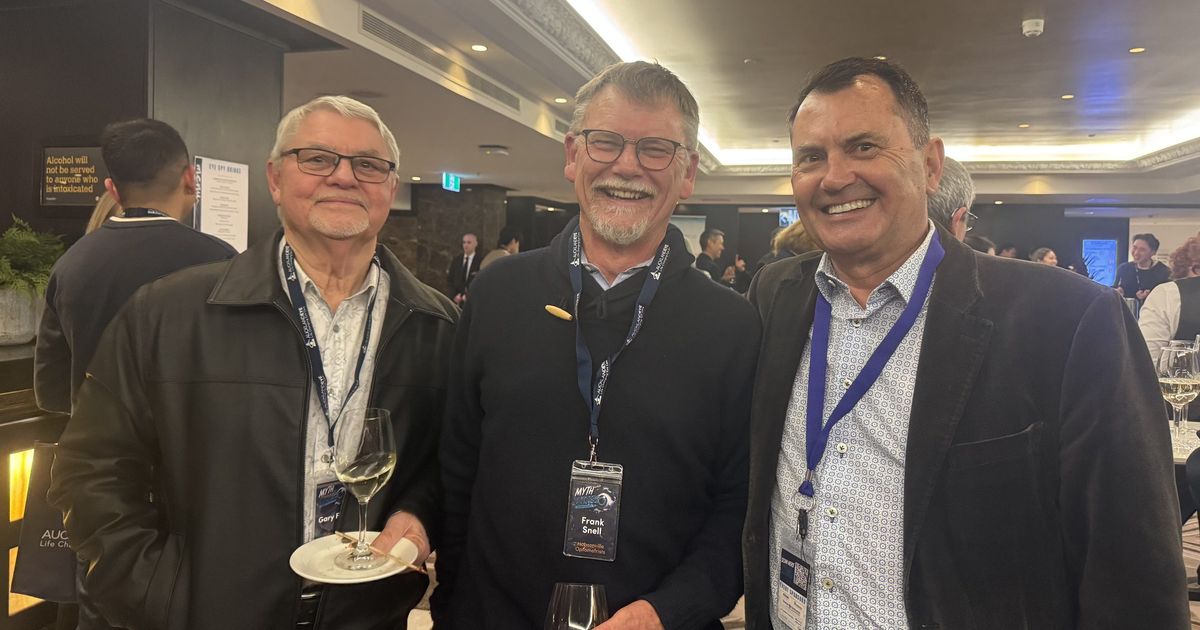
Gary Fisher and Frank Snell with MC Dr Justin Mora
The belief that eating carrots improves night vision is a myth that originated from British propaganda during World War II, according to the evening’s first myth-buster, Dr Sarah Hull. The British Government promoted the idea that consuming carrots enhanced night vision to explain the exceptional success of the Royal Air Force’s night fighter pilots and draw attention away from its new Airborne Interception radar technology. However, Dr Hull did say that vitamin A supports vital functions in the visual system and a severe deficiency – a common challenge in developing countries – can lead to permanent vision loss. Autism spectrum disorder is an established risk factor for vitamin A deficiency. That’s especially the case in boys with restrictive diets due to food aversions, she said, sharing a 2024 study exploring management options, which she co-authored with several other local ophthalmologists.
Does nAMD mean lifelong monthly injections?
Moving on to age-related macular degeneration (AMD), the second myth-buster, Dr Joel Yap, said it’s not true that AMD equals blindness as even patients with end-stage AMD retain some peripheral vision and the ability to navigate. It’s also not true that patients with neovascular AMD (nAMD) are doomed to lifelong monthly injections because second-generation anti-VEGF drugs enable ophthalmologists to extend the interval between injections for most patients with stable results, he said. For example, two-year results from the TENAYA and LUCERNE studies showed that nearly 78% of faricimab (Vabysmo)-treated patients achieved dosing intervals of 12 weeks or longer, with 63% reaching 16-week intervals.
New treatment options for dry AMD are also being explored, with Auckland Eye recruiting patients for i-SIGHT2, a randomised, sham-controlled trial evaluating the safety and effectiveness of the non-invasive i-Lumen AMD System, which uses microcurrent electrical stimulation, Dr Yap said. For more about this study, see below.
The faces of friendly competition: Karthigan Param (OPSM) and Philip Walsh (Specsavers)
You might also like
Optometry Features
Share
Susanne Bradley
NZ Optics
A senior reporter at NZ Optics. With nearly 10 years at NZ Optics, Susanne has gained an in-depth knowledge and understanding of eye health and the optics industry in New Zealand.
Related Articles
Optometry Features
Dr Justin Mora: beyond the clinic
Dr Justin Mora, co-lead of Te Whatu Ora’s Eye Health National Clinical Network, discusses his career, contributions to ophthalmology
23 Oct 2026
Optometry Features